By Ronald Williamson, EdD, and Barbara R. Blackburn, PhD
School leadership is a demanding job. You’re expected to stay current on the latest information impacting students and their learning, on the law and its implications for your school, and on curricular and instructional innovations. But, too often, the demands of the job mean little time is available to devote to your own professional learning.
Marzano Research identified several trends that would shape K-12 education in 2025 (Scott, 2024). Some are predictable, like changes at the federal level and teacher retention. Others reflect the growing impact of technology on education—things like AI (artificial intelligence), online/hybrid learning and virtual reality.
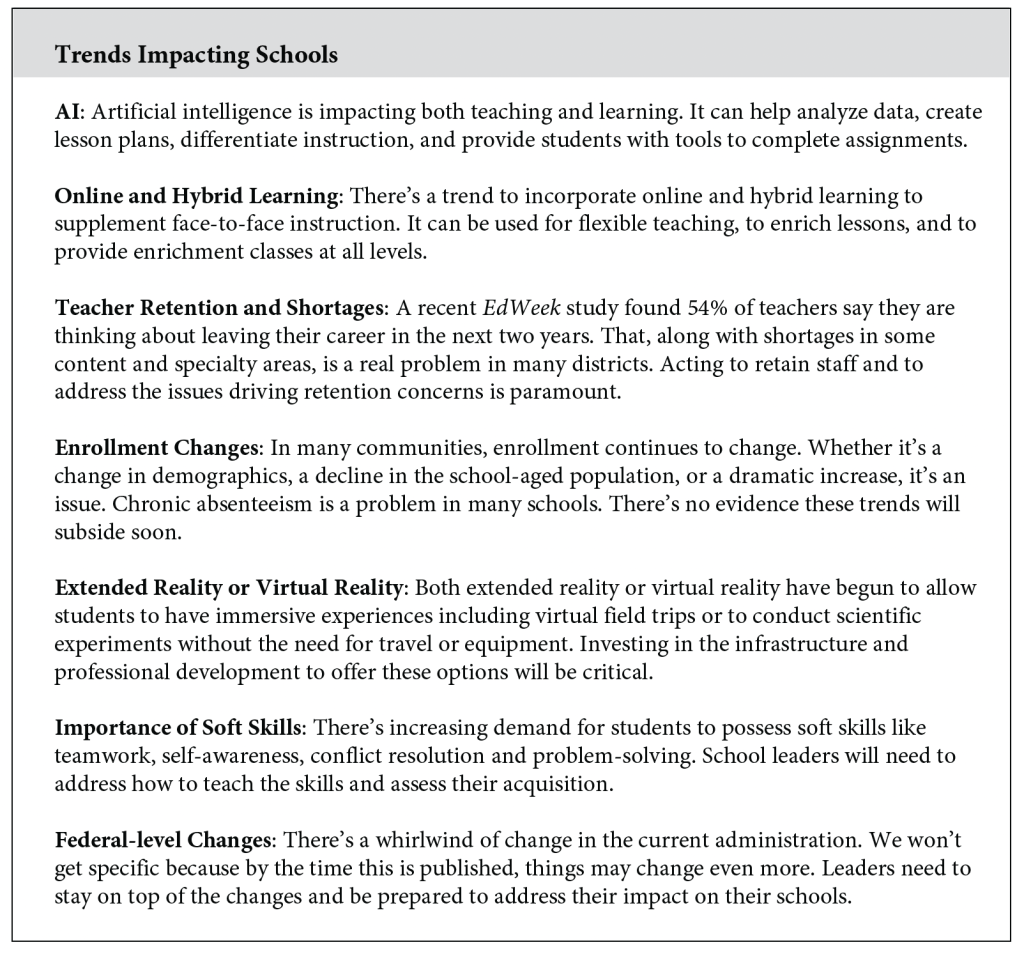
Insightful leaders recognize things change, and change can be a challenge. Interestingly, Marzano Research suggests the more difficult issue may be deciding what to work on, rather than the process of change itself. This requires changing old habits, adjusting perspectives and valuing the importance of your own learning.
Responding to Change
These shifts reinforce the importance of continuous learning. The seven trends have a common theme—change is continuous and at an accelerating pace. As a principal, how will you respond to change beyond your control? Or how can you anticipate change when change is around every corner? There are eight steps you can use to learn and be prepared to respond.
- Analyze your environment: Scan the environment in which your school exists—district, community, state, nation, and world. Consider the seven trends identified by Marzano Research. Identify issues that affect your school and those that affect the world more broadly. These trends and issues often emerge as important. What do you need to learn about these trends? Where can you gather that information?
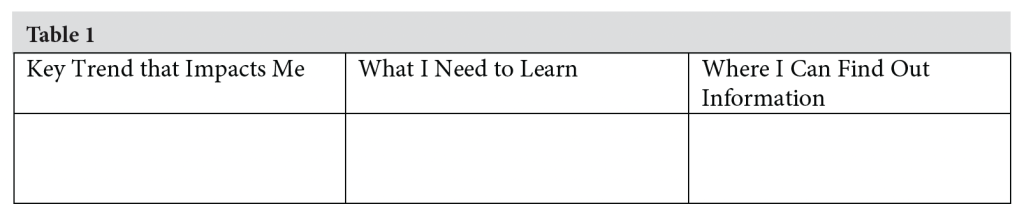
- Monitor changes in the environment: Read voraciously, talk with a broad selection of people in your community, and stay current with trends at the state and national level. Learning from people outside of education and those who share a different point of view often expands our learning.
- Identify the factors needed for success: Look beyond the traditional educational factors (good teachers, money) and consider emerging issues such as the maturing of the community, the ability to acquire and use technology, and the ability to respond to changing conditions. Connect with leaders outside of education and learn how they respond to these challenges.

- Think about your assumptions: After identifying some of the assumptions you hold about your school and its environment, test those by assessing their degree of certainty (high, medium, low) and the level of impact (high, medium, low). Assumptions play an important role in constructing the future, and they should be as reliable as possible.
- Develop a vision of an alternative future: Consider the issues you think will have an impact on your school and the factors you identified that are critical to success. Develop a vision of the future that is different from current circumstances. The creation of several alternatives is even better. Base your vision, and the alternatives, on things you’ve learned, data you’ve collected, and the ideas of people you consulted.
- Consider the alternatives: Discuss every option to identify the most likely one and to begin to think about how to respond to this likely situation. Test the alternatives with other principals, leaders in other fields, and those in your professional network.
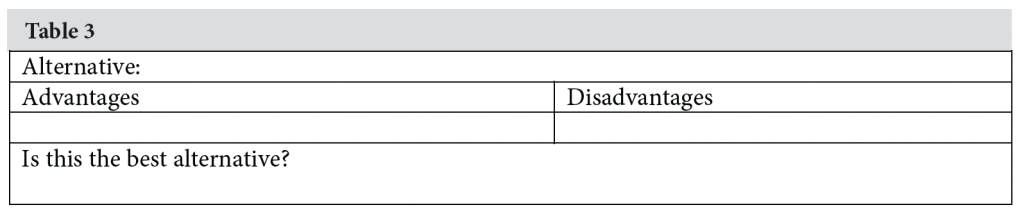
- Develop plans for needed action: Identify steps that can be taken to respond to the anticipated future. “Hedging strategies” can help to cope with undesirable future. “Shaping strategies” can help create the desired future.
- Implement plans and monitor progress: Launch initiatives to create the desired future and gather data about progress. Use this data to continue the process by scanning the environment and planning for the future. Although it is impossible to predict the future, it is possible to anticipate the trends and issues that will impact your school.
How Does a Leader Respond?
We work with dozens of principals every year, and we’ve come to appreciate the challenge of their work. Principals are asked to solve some of the most complex and contentious issues in schooling. From these principals we’re learned things you can do to continue your own learning.
The good news is that today it’s easier than ever to stay up-to-date and connected. It’s now possible to create your own personalized learning plan focused on your unique interests and needs.
Your Own Personal Learning Network
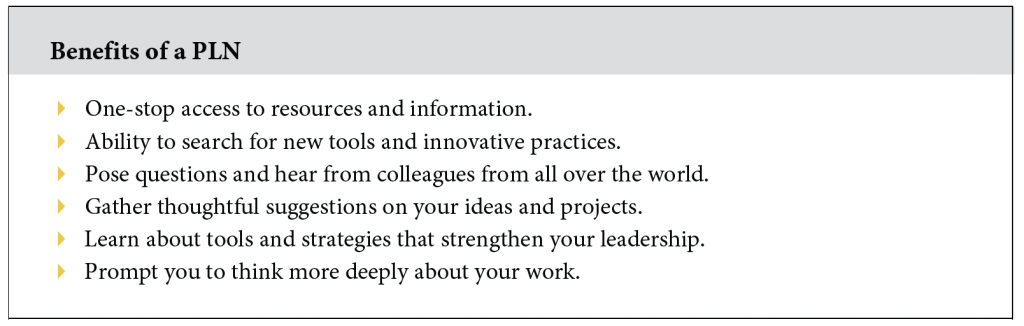
A Personal Learning Network (PLN) is an online system to help principals take charge of and manage their own learning. It is a relatively new term that grows out of the easy access to online tools to build a network of colleagues and friends who can support one another’s learning. It’s very individualized and you control the level of engagement.
Leaders have always networked and sought advice and assistance from colleagues and friends. But those “traditional” networks were often confined to colleagues in one’s own organization or personal friends. Those networks provided an opportunity to talk, share ideas, and offer suggestions about one another’s work, exactly what the new virtual network will do.
Technology allows a leader to expand on these “traditional” networks by creating a virtual network that allows you to gather information and get responses to issues in a real-time environment. By creating your own PLN, you can customize your contacts and the information you access. You can interact with and learn from colleagues all over the country, even all around the world. You can join the interaction, or you can choose to just read and consider the ideas. That’s one of the benefits of a virtual network—your ability to personalize the resources you access and control the amount of interaction.
Most importantly people appreciate the ability to customize the information they receive and to control their level of interaction.
Creating Your Customized PLN
One of the values of a PLN is that it can become your “one stop” source for information. You can create links to your favorite professional organizations, to blogs written by some of your favorite authors or someone who spoke at a conference, or to sites that deal with a current issue in your school. The resources are “virtually” unlimited. Here are five steps to creating your own PLN.
Step 1: Determine Your Focus
Spend some time thinking about where you might want to start. What’s something you want to know more about? What’s a topic of discussion in your school? What’s an organization, or a person, you’d like to stay connected to?
You may want to think about those individuals and groups you turn to when you want information about an issue in your school. Perhaps it’s a professional organization like TEPSA, ASCD, or NAESP. It might be a site with information about a program in your school. It might even be the blog of an author or speaker who you found informative. Regardless, determine an area of interest to focus your PLN.
Step 2: Create an Account for Your PLN
Probably the easiest way to build a PLN is to create an account on a social media site where you’re comfortable. Some options include LinkedIn or Feedly. It’s easy to discount social media as a tool for sharing minutia, but it can also be a powerful way to connect with professional colleagues. We have X and LinkedIn accounts and use them for our own professional learning. We separate our professional learning from our personal contacts. Like Ron, you don’t need to “tweet” but, instead, can use X to access current information that helps your work.
Step 3: Find Your Links
Once you have your account it’s time to find the people or organizations with whom you want to connect. Start by doing a search to identify people or groups that are interested in the same topic. You probably already know many of them. Narrow or expand your search, if needed, to identify links. Bookmark, or link, the sites you find of greatest interest or use a tool like Feedly to create a reading list that will send you automatic updates from the sites.
Step 4: Determine Your Level of Participation
Part of joining a network is to both learn and share information. Most people move through a set of predictable stages when they first create their PLN. At first, they remain in the background, reading, listening, and learning. As they become comfortable, they become a more active participant. They evaluate their contacts and edit their network to assure the right balance between their own learning and their personal and professional lives. That’s one of the benefits of a PLN, the ability to tailor and customize both the information you receive and your level of involvement.
Many people share links to articles they’ve read, presentations they’ve seen, videos they’ve watched or other tools they find helpful. You can also pose a question, and you’ll be amazed at the array of responses you receive. That’s an easy way to join the conversation and become comfortable with a virtual network.
And, of course, you can close the network or unfollow people or groups whenever you want.
Step 5: Manage Your Network
It’s important to monitor your involvement. Just like reading a journal, you don’t have to read everything that is posted. But you will want to scan the links and see what might contribute to your own learning. A few minutes every day, or every other day, helps you manage your involvement. Ignoring your PLN can lead to feeling totally overwhelmed because of the posts and links you’ve received. It’s the same as letting your favorite journal or set of books pile up while waiting to be read.
A Final Note
It is important for principals to stay current on issues impacting their school and their leadership. Whether it is traditional tools like journals, books and conferences, or a virtual tool like a PLN that allows you to access resources and information anytime, anywhere, it’s vital to be a learner and to model the importance of learning.
Dr. Ronald Williamson is Professor Emeritus of Educational Leadership at Eastern Michigan University. He is a former principal, central office administrator and Executive Director of National Middle School Association (now AMLE).
Dr. Barbara R. Blackburn, a Top 10 Global Guru, is a best-selling author of more than 30 books, including the bestseller Rigor is NOT a Four-Letter Word, Rigor for Students with Special Needs, Rigor in Your School; 7 Strategies for Improving Your School, and Improving Teacher Morale and Motivation. An internationally recognized expert in the areas of rigor, motivation and leadership, she regularly collaborates with schools and districts for onsite and online professional development. Learn more.
Reference
Scott, O. (2024). 2025 Education Insights. The hottest topics in education for 2025. Marzano Research. Retrieved online from https://marzanoresearch.com/hot-topics-in-education-2025/
TEPSA Leader, Fall 2025, Vol 38, No 4
Copyright © 2025 by the Texas Elementary Principals and Supervisors Association. No part of articles in TEPSA publications or on the website may be reproduced in any medium without the permission of the Texas Elementary Principals and Supervisors Association